
Engaging Your 1-Year-Old Baby: 8 Fun Games That Require No Toys
· Updated · 8 min read
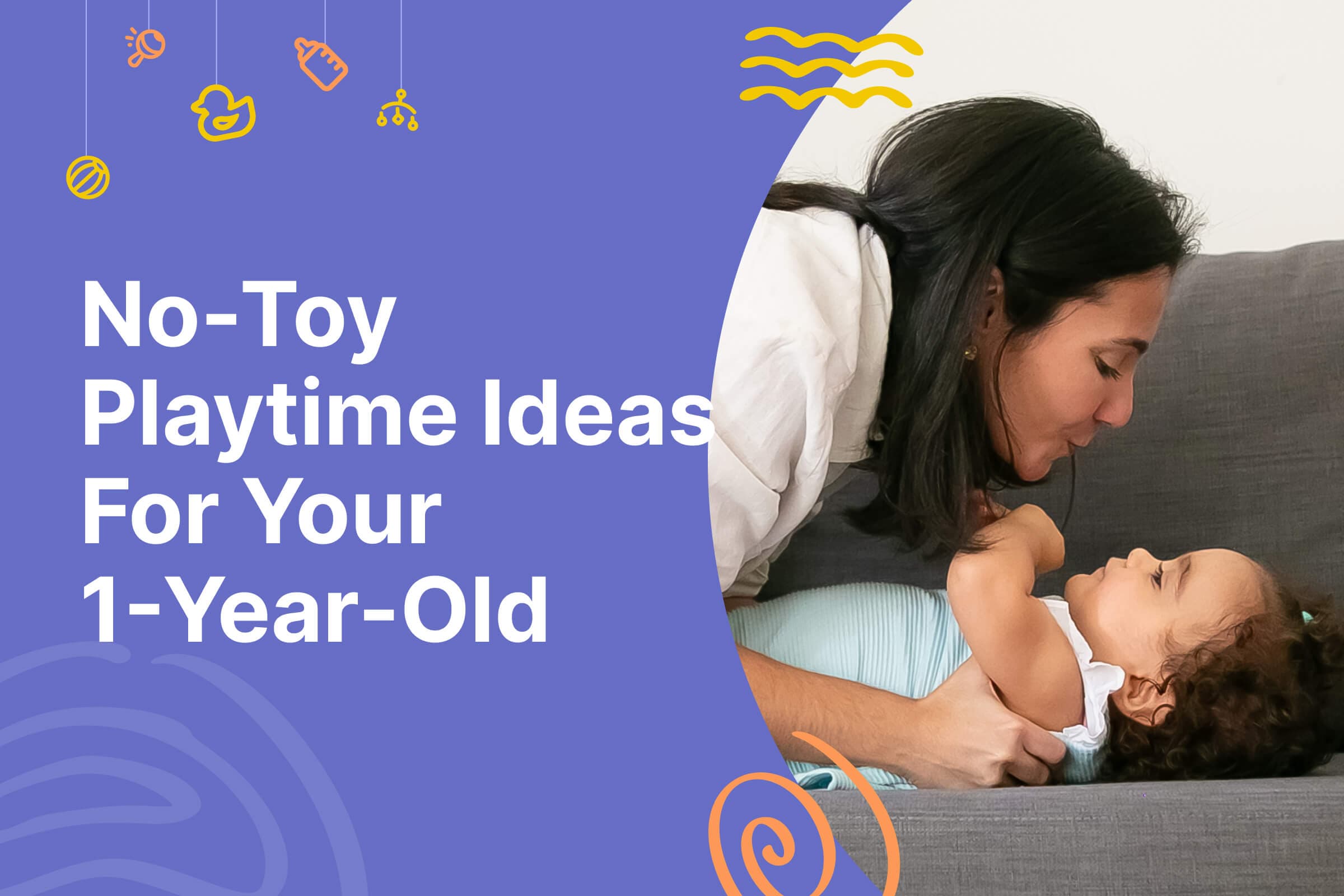
The best games for a 1-year-old don't need any toys: peek-a-boo, singing and dancing, mirror play, pat-a-cake, naming body parts, Simon Says, treasure hunts and blowing bubbles. All you need is yourself, a few things from around the house and a bit of time.
Playtime helps your baby build cognitive, social, emotional and physical skills. Below, we explain how to play each game and what your baby gets out of it.
Benefits of engaging your 1-year-old baby in playtime
Besides being fun, playtime supports your baby's thinking, movement, social, emotional and language skills.
| Benefit | Description |
|---|---|
| Cognitive Development | Playtime stimulates a baby’s brain. Games like peek-a-boo and naming body parts can help with memory and attention span. |
| Physical Development | Movement-based activities like dancing and obstacle courses improve motor skills. Sensory activities, like water play or sensory bins, support sensory development. |
| Social and Emotional Development | Playtime encourages interaction and emotional expression. Imitation games and puppet shows also help with communication and language. |
| Bonding and Relationship Building | Playing together strengthens the bond between parent and child. |
| Language Development and Communication Skills | Talking, singing and nursery rhymes help build vocabulary and understanding. Games like pat-a-cake also help with language development. |
1. Peek-a-Boo
Peek-a-Boo is a classic game that has been played for generations. All you need is your face and a blanket or your hands. Here’s how to play:
- Cover your face with a blanket or your hands.
- Peek out from behind the blanket or hands and say “Peek-a-Boo!”
- Watch your baby’s reaction as they try to figure out where you went.
Benefits of playing Peek-a-Boo
Playing Peek-a-Boo with your baby can help them develop object permanence, the understanding that an object or person still exists even when they can’t see it.
It can also help develop social and emotional skills, as babies learn to anticipate and respond to interactions.
2. Singing and Dancing
Singing and dancing are easy ways to play with your baby. You don’t need any toys or props, just your voice and some simple movements. Here’s how to do it:
- Choose age-appropriate songs for your baby. Nursery rhymes and children’s songs are great options.
- Sing the song to your baby while doing simple movements like clapping, bouncing, or swaying.
- Watch your baby’s reaction as they try to mimic your movements.
Benefits of singing and dancing with your baby
Singing and dancing can help your baby develop language and communication skills. It also helps build physical coordination and gross motor skills.
3. Mirror Play
Mirror play is a simple game you can do almost anywhere. All you need is a mirror or any reflective surface, like a window. Here’s how to play:
- Sit in front of a mirror with your baby on your lap.
- Make faces, stick out your tongue, or make silly noises.
- Watch your baby’s reaction as they try to copy your movements.
Benefits of mirror play
Mirror play helps babies develop self-awareness and learn about their own bodies. It also helps develop visual and cognitive skills, as babies learn to recognize and differentiate between their own movements and those of others.
4. Pat-a-Cake
Pat-a-Cake is a classic nursery rhyme that doubles as a clapping game. Here’s how to do it:
- Sit facing your baby and hold their hands.
- Say “Pat-a-Cake, Pat-a-Cake, Baker’s man, bake me a cake as fast as you can.”
- Clap your hands together and then clap your baby’s hands together.
- Repeat the clapping and hand-holding sequence several times.
Benefits of playing Pat-a-Cake
Playing Pat-a-Cake can help develop hand-eye coordination and gross motor skills. It also helps develop language and communication skills, as babies learn to mimic sounds and gestures.
5. Body Part Identification
Body part identification is a simple game that helps babies learn about their own bodies. Here’s how to do it:
- Sit facing your baby and point to a body part, such as the nose, ear, or mouth.
- Say the name of the body part out loud, such as “This is your nose.”
- Ask your baby to touch or point to the body part you named.
- Repeat with other body parts like eyes, ears, and mouth.
Benefits of body part identification
Playing body part identification helps babies develop body awareness and language skills. It also helps with sensory development as babies learn to recognize different textures and sensations on different body parts.
6. Simon Says
Simon Says can be adapted for children as young as one. Here’s how to do it:
- Stand facing your baby and say “Simon says touch your nose.”
- Touch your own nose and then watch your baby try to touch their nose too.
- Repeat with different body parts or actions, but only say “Simon says” before the action you want your baby to do.
Benefits of playing Simon Says
Playing Simon Says can help develop body awareness, listening skills, and following directions. It also helps with language development, as babies learn new words and actions.
7. Treasure Hunt
Treasure Hunt can be played indoors or outdoors. Here’s how to play:
- Hide an object your baby knows, such as a stuffed animal, a cushion or a shoe, somewhere in the room or yard.
- Encourage your baby to search for the object by saying things like “Where’s the treasure?”
- When your baby finds the object, praise them and give them a hug or a high-five.
Benefits of playing Treasure Hunt
Playing Treasure Hunt can help develop problem-solving and decision-making skills. It also promotes physical activity and gross motor skills as your baby moves around to search for the hidden object.
8. Blowing Bubbles
Blowing bubbles is an easy activity you can do indoors or outdoors. Here’s how to do it:
- Purchase or make a bottle of bubble solution.
- Blow bubbles and watch your baby try to catch them or pop them.
- Encourage your baby to try blowing bubbles themselves.
Benefits of blowing bubbles with your baby
Blowing bubbles helps develop visual tracking skills as your baby follows the bubbles with their eyes. It also promotes physical activity and hand-eye coordination as your baby tries to catch or pop the bubbles.
More No-Toy Playtime Ideas
Here are more no-toy ideas to keep playtime fun and support your baby’s development.
| Game Name | Description |
|---|---|
| Scarf Play | Gently toss a light scarf back and forth and let baby reach for it as it floats down, to encourage gross motor skills and hand-eye coordination. |
| Puppet Show | Use your hands or stuffed animals to create a simple puppet show for your baby, encouraging their imagination and language development. |
| Water Play | Give your baby a bowl or tub of water and non-toxic items like cups, spoons, and sponges to splash and play with. This can help with sensory development and hand-eye coordination. |
| Sensory Bins | Fill a container with safe household items of different textures for your baby to explore. This encourages sensory development, problem-solving, and fine motor skills. |
| Homemade Shakers | Make shakers by filling empty containers like water bottles or yogurt cups with small items like beans or rice and sealing them shut. Your baby can shake them to create sounds and learn about cause and effect. |
| Face Painting | Use non-toxic, washable paints. This encourages creativity and imagination, and is a fun activity for special occasions like birthdays or holidays. |
| Obstacle Course | Set up a simple obstacle course using pillows, blankets, and furniture to encourage gross motor skills and physical activity. You can also incorporate simple tasks like crawling under a blanket or jumping over pillows to make it more fun and challenging for your baby. |
| Imitation Games | Encourage your baby to imitate simple tasks like clapping or waving. This can help with language development and socialization as they learn to communicate and interact with others. |
Playtime with your 1-year-old doesn't have to be complicated or expensive. These 8 games need no toys and can be played almost anywhere, any time. They also support your baby's development, from thinking and movement to social and emotional skills. Have fun with your little one!
FAQs
1. Can these games be played with multiple children?
Yes, these games can be adapted for several children of similar ages. Siblings or playmates can join in too.
2. How long should playtime last for a 1-year-old?
Play for as long as your baby is interested. A good rule of thumb is 10-15 minutes at a time, several times a day.
3. What other activities can I do with my 1-year-old besides these games?
You can read books together, go for walks, play with blocks or stacking toys, and try sensory play with water, sand or playdough. Soft cloth books and a baby-safe mirror book are easy ways to add reading and mirror play to your day.
4. Can these games be adapted for babies with disabilities?
Yes, these games can be adapted to suit each baby's needs and abilities.
5. Is it necessary to play with my 1-year-old every day?
Yes, try to play with your 1-year-old every day. It builds a strong bond between you and supports your baby's overall development.
The Most Popular Baby Gifts for Newborns
Our gift sets are put together to give babies positive early learning experiences and to help new parents. We have a wide selection of baby gifts for baby girls, baby boys and new parents.
Take a look at our baby gift sets today and find a present for your loved one. We deliver quickly and reliably, straight to their doorstep.
You might also like
Preparing For Baby’s Arrival: A Checklist Of What To Do And Buy Before Your Little One Arrives
Before your baby arrives, get the essentials ready: a crib, a car seat, a stroller, diapers and wipes. Then add nursery, feeding, diapering and clothing items. Here is a simple newborn checklist to help you plan and budget.
Understanding your baby’s sleep patterns and creating a sleep routine
A good baby sleep routine comes down to regular nap and bed times, the same calming steps every night, and a dark, cool, quiet room. Here is how baby sleep works, how to build a routine, and how to handle common sleep challenges.
Developmental Stages: Baby, Newborn, Infant, and Toddler Definitions
What is the difference between a baby, a newborn, an infant and a toddler? This guide explains each stage of early childhood, from the first weeks after birth to age three, and how physical, cognitive, emotional and social skills change along the way.